Throwback: Meeting Notes 21st June 2025
The thing of course is that Carmilla is capable of very different sorts of readings
What we talked about when we talked about Carmilla.
Caveat Lector: the QRB book club is a place for our subjective opinions, and our opinions tell you a lot about us, and less about the book. This is not a "Read this book" or a "Don't read this book", it has no critical weight — this is an archive, a summary, a battered cliff notes edition soaked in blood and half truths.
We got a little rowdy so at some point I wasn't taking amazing notes. (One of us was like, I thought for Carmilla we'd have a peaceful discussion which I think denotes an optimistic nature which thinks well of humanity).
The thing of course is that Carmilla is capable of very different sorts of readings
- Carmilla is heteronormative propaganda about how lesbians are bad and evil and monstrous 🧛🏻♀️
- Carmilla is a queer narrative of the ways in which comphet hems in our thinking and the ways in which men keep women in the dark about things that matter to them 🧛🏻♀️
- Carmilla has a tongue in cheek factor where the audience is in on the joke – that Carmilla is a vampire and a lesbian and it's incredibly obvious and in the stage play she's in everyone has to be oblivious but the audience knows. (Someone mentioned Jordan Peele talking about the thin line between horror and comedy)🧛🏻♀️
Some things we argued about:
- Did Carmilla want to be defeated at the end? Some of us argued yes – she didn't attack the general beyond disarming him even though he is a proven threat to her. Some of us argue no – disarming and escaping seems her style. Does her gender play into this? (Yes and no.) (A note: this is how a lot of women are taught to do self-defense – not the Vulcan nerve pinch part, but the getting away part)
- Was the person in the coffin Carmilla/Mircalla/Millarca? Or was it a human patsy who looked like her? Living breathing? But then how did she get into the coffin?
- Did Carmilla survive? This actually wasn't an argument but sort of glanced on as we went through the other points. If yes, did Carmilla survive because she had a human patsy or because after she was staked beheaded and burned she regenerated?
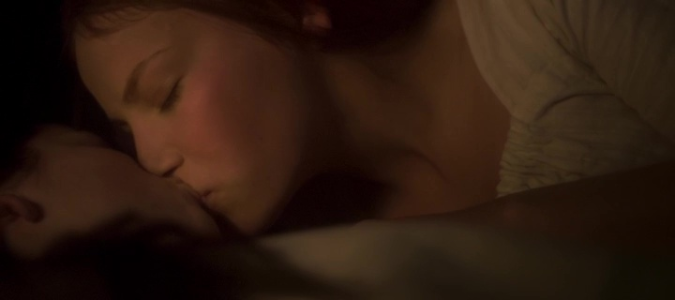
- One of the things we agreed on was that Laura was attracted to Carmilla. Le Fanu paints this attraction as coming with repulsion . As readers today, do we see that as internalised homophobia on Laura's part, of the narrative saying that Laura was repulsed through some deep instinctive knowing of Carmilla's monstrousness (using monstrousness as a loaded word here)?
- Things we didn't have time to discuss in detail was consent – vampire lore is not about the consent lol. We did not follow this thread to the conclusion of talking about assault. Certainly Laura has given no open consent, never mind informed consent
Things some of us were more interested in than others:
- The exact logistics of the feeding. We see three modes of what Carmilla can be: cat, palpitating mass, pretty woman. There was a LOT of discussion (sort of going nowhere) about where the attacks were physical and where they were spiritual – I was literally trying to measure inch vs two inch to see what was feasible, what was directly alluded to in the text, what was just glanced over l. I have no shame about this but some of the others got bored
An interesting point that came up late in the discussion (in reaction to the in-depth discussion of technicalities of feeding) is that all of these details are just plot points to move around the central theme of Laura – as a lonely figure, as a motherless figure, as a sheltered figure, as a religious figure, as a not very deeply fathered figure, and as a figure who is vulnerable to – lesbians/monsters/ more sophisticated people/more self-centered people.
There were free ranging discussions around class and class status that allowed you to get away with things – Carmilla and her 'mother' both use this power to do things they could not otherwise do, and Carmilla actively is like 'please beat up common men who insult my teeth' like this is a reasonable thing to want – and maybe for a Countess in Styria in the 1500s it was!
Notes on family:
- Mircalla the original is a Karnstein. Laura's mother is descended from the Karnsteins, though they don't exist as a line anymore. Is this is the source of Carmilla's fascination with Laura?
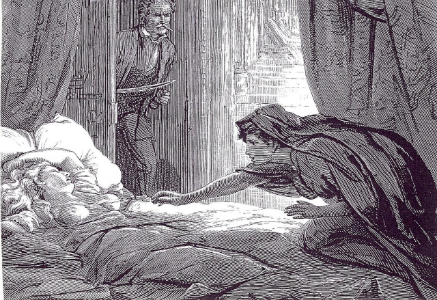
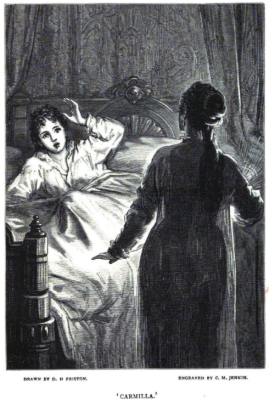
- Is this family connection why Carmilla was in Laura's bedroom when she was eight?
- A quick note that it's an incredible coincidence that the family paintings are being renovated/retouched/refurbished when Carmilla is there. Or is it? My headcanon (which was too boring for people to disagree with) was that maybe Carmilla heard about it (somehow) when she was in town gadding about with Drink of the Week, and then was reminded of Laura and decided to come see her?
- Laura's dad is so checked out. He reminded us of Mister Bennet but even Mister Bennet had the good sense to talk to Jane and Lizzie. Also: in the paintings scene, he is so uninterested in Carmilla, while Laura is like, she looks like you! She has your mole (HOW DID YOU KNOW ABOUT THE MOLE LAURA they had sex lol) I want this in my bedroom! Like, Laura absolutely is attracted to Carmilla
- Laura's dad is checked out but he does consult with local doctors etc. so people trust him? Useless, all of them
- Were the people with Carmilla thralls? Vampires? Willing human servants?
- Has Carmilla been visiting the castle all these centuries, checking in on her family? (Where is Laura's mother?)
Okay so: Laura. Laura is our narrator, our letter writer, the central fascination of the book's central creature.
- But sometimes she can be so dumb -- Carmilla is like 'I love you, kisses and caresses' and Laura is like 'oh you must have a boyfriend!'
- Laura also never makes any connections, at all, between weird goings on around her home and her new visitor. To be fair, neither does anybody else
- None of these people have the scientific/investigative temperament. Carmilla is the one who talks about science! Laura's dad comes close with considering she must be sleep walking but he does so based on no information
- But this might not be that Laura is dumb -- it's more likely to be comp het so comp she can't even fathom queerness. (At one point she wonders if Carmilla is a boy dressed up as a girl to come get close to her)
- Laura is also sheltered af. From the time in her childhood with the incubus in her bed, things have been hidden from her. She remembers but has nothing to grapple with. When she's ill the dad calls the doctor and the two talk about her without her. In a well meaning, paternalistic way. She's not encouraged to do much thinking for herself and she's eighteen
- (Dumb blonde joke)
- Carmilla also tells such lies -- why not believe that the beautiful mysterious woman is having the same dreams as you as opposed to attacking you in your sleep as a cat?
- Laura's loneliness is something we don't explore – Carmilla is the ONLY person her own age we see her interacting with, and it's implied she has no close friends as a child (thought that just occurs to me – if they had been a little more rebellious/class iconoclastic she could have hung out with the local girls in the village!
- Also very self deprecating about her loneliness and depression
- This could have been a family point but it only occured to me now so I am putting it here: Laura is religious, surrounded by religious and superstitious people. We all agreed I think that the people around her knew that something supernatural - an incubus? - had been in her bed when she was eight. They brought in a priest, they did their best to make her forget it, but she grew up with faith but not a community to have that faith in
- (One of her only discordances with Carmilla was about faith, though she didn't know it. As the funeral passed by and she began to sing the hymn with them, Carmilla is rude to her, but she doesn't seem to be hurt or feel she's owed more. She just goes hmm Carmilla is angry. Is Carmilla angry because Laura is religious because Laura has hurt her with the hymn? Later this is something Laura specifically wonders about Carmilla – but doesn't ask
- At the beginning of the book, we know that Laura is dead. She is at least 28 when she dies but like her mom passed away young. Is this just because people die young sometimes? Was it because Carmilla had made her mark on her? Was it because she did something about it? Was it because Carmilla came back?
- She is still haunted by Carmilla
- She still sort of wants to be haunted by Carmilla
- Maybe Carmilla is there with her light step in the drawing room
- I wrote these notes past midnight with the lights off and I was creeped out 😭
Other notes on the novel:
- The prose is gorgeous. The plot is a little thin but the vibes are VIBEY
- Whether the novel is homophobic or homoqueering, the novel itself has a lot of eroticism (someone mentioned that on the audiobook a lot of the groans sounded like moans)
- The sexiness of fear yes?
- So overall this was very worth reading!
Things where I just wrote down the names but not why:
- Dahmer. I cannot remember why we talked about him but we did
- Jane Austen. Northanger Abbey!
- Lots more Dracula than I've mentioned but these are bullet points 😭
- The annotated version by Carmen Maria Machado which is totally worth it if you like CMM or if you need help because you think Carmilla is a homophobic book. For me, CCM's framing rescued the book for me — she makes small changes in the text iirc
Lastly I would like to point out that a book with two female characters means everyone in the book club is saying she all the time and it was super confusing, like being at a family function and everyone looks alike but you dunno who anyone is.
What to read if you liked Carmilla:
- 1764: The Castle of Otranto — this is the gothic novel I recommend to everyone. It is weird af and drama af and passion af and tragedy af
- 1817: Northanger Abbey — Jane Austen's satire of gothic literature. Very fun
- 1818: Frankenstein by Mary Shelley (1818 version; 1831 version). Dr Frankenstein creates a person and treats it like a monster. Very very good writing
- 1819: The Vampyre by John Polidori — the first novel in English about vampires? Like they existed in folklore but no one put them in a novel until 1818
- Quick note: John Polidori and Mary Shelley wrote these novels while they were on holiday together with Percy Shelly and Byron!
- 1820s to 1840s Edgar Allan Poe: The Raven (poem), Fall of the House of Usher, The Tell-Tale Heart
- 1847: Wuthering Heights by Bronte
- 1886: The Strange Case of Dr Jekyll and Mr Hyde by Robert Louis Stevenson. Not queer necessarily though I think you could do a reading that way
- 1890: The Picture of Dorian Grey by Oscar Wilde (1890 version; 1891 version) — openly queer, very gothic inspired but more openly psychological
- 1897: Dracula by Bram Stoker — perhaps even more influential than Carmilla about vampires. It's very sexy and very sciencey.
- 1899: Powers of Darkness by A-e, which pretended to be a translation of Dracula into Icelandic but is actually only loosely based on it
- The Nosferatu movies — possibly THE reason we STILL talk about vampires and their sexiness
- 1962: We have always lived in the castle by Shirly Jackson — fucked up families living in old houses with an 18 year old narrator hmmm hmmmm
- 1995: I who have never known men by Jacqueline Harper — a bunch of women alone together cos they're in a cult
- 2018: Carmilla and Laura by S.D. Simpson
And lastly, multiple people recommended the Carmilla webseries and movie!