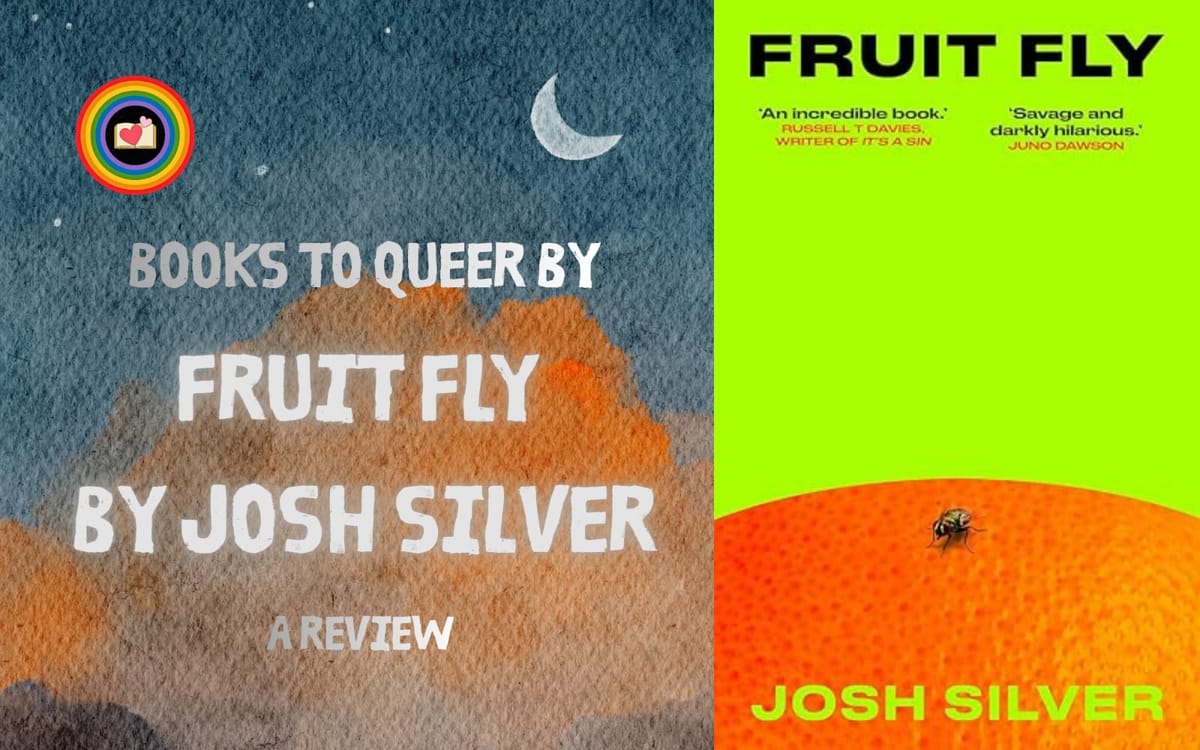
Fruit Flies Like A Banana: Review of 'Fruit Fly'
Enjoyment is amplified if one has read Virginia Woolf closely. It is amplified even more if one hasn't, but has pretended to have read it.
It's 2 am. My kindle says 80% read. My eyes are watering. My brain is screaming at me to put the book down. To sleep.
I can't. I'm reading Josh Silver's debut novel, Fruit Fly.
Fruit Fly (2026) is a fast-paced rollercoaster set in the UK about a well-to-do has-been writer, Mallory, who is stuck in a complicated marriage and chasing a young, drug-addicted gay man's trauma to write her next book. Her ticket out. She writes amidst a web of secrecy that gradually shifts our perspective on who is crazy, who is in pain, even who is actually doing the writing. A page turner, Fruit Fly can easily be devoured in a few hours.
Listed as one of 2026's must-read books by the BBC, Fruit Fly gained traction among readers after Jack Edwards gifted it to Anne Hathaway. Its testimonials describe it as incredible, distinctive, provocative, propulsive, dark, gripping, and propulsive again.
The perspective alternates between Mallory and Leo (the gay man), with dark, hilarious inner monologues that are extremely unreliable. Enjoyment is amplified if one has read Virginia Woolf closely. It is amplified even more if one hasn't, but has pretended to have read it. With such shenanigans, the book seems to invite us to laugh at the publishing world, even as it reminds us of the commodification of trauma stories and the cruel apathy inherent in it. Given the book's subject matter, it is simultaneously impossible for the reader to extricate oneself from the logic of this.
The narration can resemble a stream of consciousness but is in reality a line hovering between the strictly sane and the clearly insane. The thrill for the reader is to straddle that edge, not knowing which way the characters are teetering. Both Mallory and Leo are trying to escape their situation in ways that plausibly lead them into absurd situations, such as when Mallory starts to write a second book to cover the fact that she is writing a book (which is also in a sense the book that we are reading).
Young, gay Leo's world is the very opposite of Mallory's, and both relish glimpses of each other's world (as do we). We, the readers, root for them to be allies, to hold hands and help each other and emerge from their troubles and trauma together.
If only.
If anything, as the book progresses, we are uncomfortunately reminded that we too are relishing their story, just as much as they are. And in that sense, Fruit Fly offers us the same escape – with post-ironic words slicing like a knife through everything.