Reaper Man By Sir Terry Pratchett

Disclaimer: This is probably the second book I am reading with an understanding that I'm gonna be writing a review of it. The first one was a text book on Survival analysis (OOh nice symmetry), but I've written some movie reviews in the past, some published some not. I am very sure this one i read a lot more patiently, carefully and persistently than otherwise.
Note: This is a 2-part thing, I wrote the 2nd one first when I put pen to paper, but reversing the order and because it has spoilers, and I like to publish this way.
My scribbled note at the end of the book says "Reads like a bullet train engine fixed to old chassis coaches and tracks and needs to go slower to avoid derailing."
And while I wrote it; I meant it to some extent as a criticism of it being slow/draggy plot (in comparison to a detective novel). Today almost a week after finishing and ignoring the commitment I made to review the book, I think it's actually a compliment. I've read just about 10* of Terry Pratchett's novels, and he, along with Douglas Adams is on the top of my goto authors. This supposedly "slow, meandering" pace is because of the core rebellion against the standard "Hero's journey" format of Story-telling that is at the core of my love for these two authors. (Yes one could argue Douglas Adams was much less so, and not so obviously, but I'd counter-argue that Douglas Adams was doing the story orally on Radio, and the whole "man who rules the world" sequence should be evidence enough.)
I'm glad I took the week procrastinating watching TV shows, starting another book (Earthly Playing Field) etc, (I call this the buried germination phase) because one thing I repeatedly got drawn to, when I got bored and relaxed enough is "The carrier bag theory of fiction" essay by Ursula K. Le Guin. I hadn't read much of her work (Did finish listening to the Left Hand of Darkness looong ago, with surprisingly little effect on me, perhaps now is a good time to re-visit). So naturally, in an attempt to see how see practices her theory, I ended up reading The Ones who walk away from the Omelas primarily because the QRB WA groups was talking about it.
I couldn't immediately grok the connection, but now I think I do.
Both the Omelas and the Reaper Man (Thief of time or most Discworld novels really) are talking about gaps, issues, fault-lines, failures/absurdity of humanity and its efforts to civilize and collaborate instead of any one particular person's story.In that sense these stories are all containers of concepts, principles, Leaky Abstractions (Yes I do think there's a lot of these even outside of Software), flawed and failure of imaginations, eternal challenges between pragmatic hows and ideal whats etc. The real proto and anto agonists of these stories are different platonic pure forms of these concepts/principles/ideas and not the agents/beings/characters themselves. They are all bodies that embody, a mix of these proto and anta agonists, and triumph anyway in the end, even while bumbling along (sometimes cluelessly), fumbling chances, making mistakes and taking very short-term, locally optimal decisions and picking fights.
Spoilers Ahead (But also some other references that came to mind, I'd suggest you read the book anyways, because i don't think they spoil the book per se.):
One of my favourite pieces from Tamil literature goes like this:
இடுக்கண் வருங்கால் நகுக அதனை
அடுத்தூர்வது அஃதொப்ப தில்.
Turns out it is Thirukkural no: 621, I don't agree with all the kurals, but this one, has been a sustenance/survival strategy thing for a vast majority of my life. (Of late, I've come to use it in moderation only.)
I believe this was part of my aspirational aim, when I picked up the book (A family member seems to be in the last stages of life), though never put in words, this is the first thing that comes to mind when I sit-down to write. And this book lives up to it beautifully.
I'd call this book itself as one of the very best of Terry Pratchett's writing style I've come to love so far in my readings. This one, is very similar to "Thief of Time", in that it is basically a fight/conflict (and resolution) of the abstracts, super-natural forces. However as per Terry's style of not having a hero Vs Villain Stereotype; the plot runs around a few beautifully sculpted characters. Here's a list of them in no particular order, just as they arose when I first put-pen-to-paper.
- Mrs. Cake: with some live premonition, and ability to talk to beings post-death, and a lot of faith, but always disappointed (and irritated) with the priestly class, so much so that they're all afraid of her.
- Windle Poons of the Unseen University; A dead but not death(undead), Never categorized, but hypothesized Zombie and undead etc.. Lived as a Wizard; Seems to think like one after death too. Dies pretty early, and spends most of the book, playing the role of a detective who is figuring out the mystery of his "not-death"?? And yet not the hero (may be a hero?) of the story.
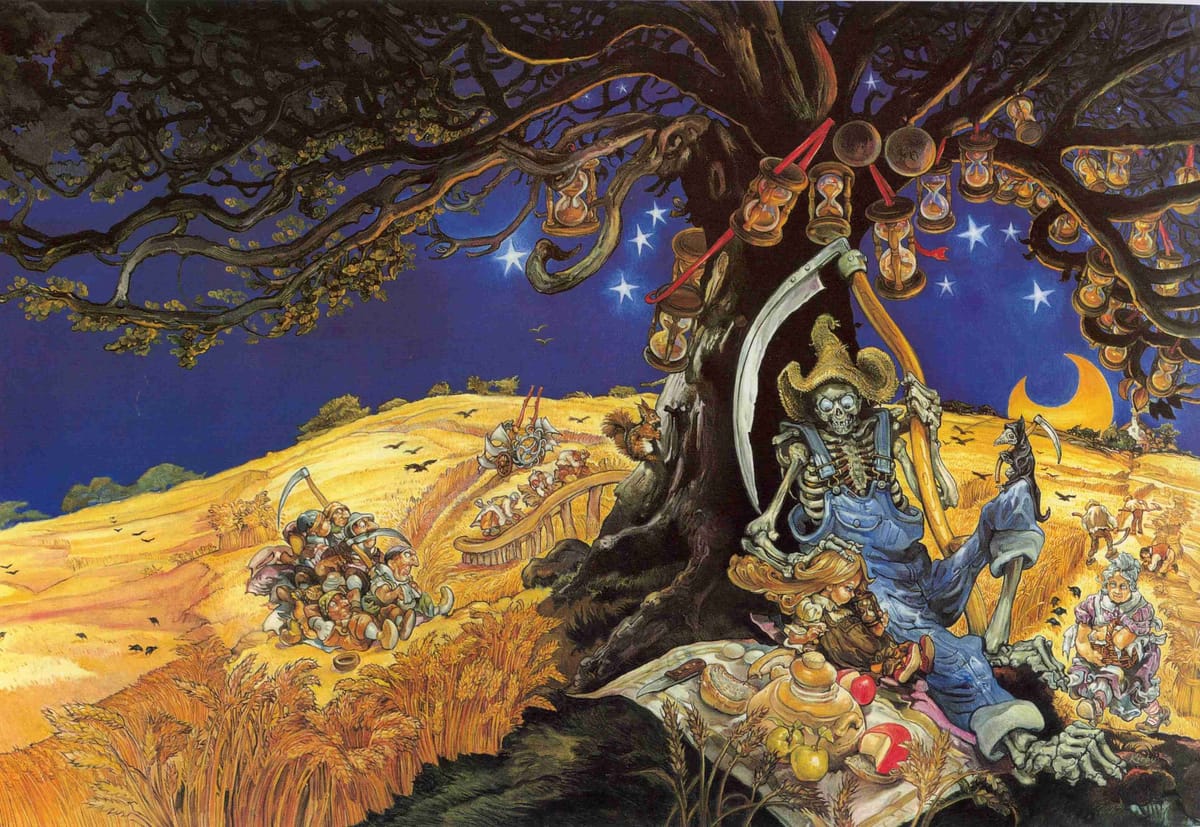
- Death (aka Bill Door)– The anthropomorphized idea of death; The one who meets people when the stop living; never dying nor living, beyond time, with his witty, dry funny commentary on humanity. Is the one who wants to live and die "in time" (and so retires and becomes Bill Door). Takes up job of Reaping the harvest.
- Mrs. Flitwick: Bill Door's Employer, Farm owner, Smuggler's daughter, Highly relatable old lady, who lives alone.
- Auditors: The grey, dull beings obsessed with order and keeping everything in accounts balanced..
- Dean and ArchChancellor of Wizards: two characters that epitomize a lot of ivory-tower characters but also the characters from Yes Minister and Yes Prime Minister. The more modern references would be Michael Scott and Dwight from [The Office](https://en.wikipedia.org/wiki/The_Office_(American_TV_series). Written as funny, sarcastic, manifestation of the absurdity in pedantic, ivory-tower bureaucracy sometimes.
Moving on, There's a bunch of 4th wall references, especially by Death, but not outright breaks I would say. I think one of my scribbled notes says, even though this feels like (forgotten Deus) ex Machina, it doesn't feel like cheating, because of the multiple character viewpoints and each doing their own struggles and dealing with conflicts (Well something like that). And then there is a short, but brilliant portrayal of this character the Engineer. There's even a fun-poking reference to Paulo Freire's Consciousness Raising..
Overall it is a very movie/theatre-makeable writing. There are some abstract conflicts, concepts, descriptions (that are more like non-descriptions), But there's plenty of detailed visual descriptions and lot of literally cut-scenes to balance it out.. I feel like this is such a dramatizable/screenable writing it's a failure that it's not a movie.(I looked it up and there's a different movie with this name... sigh.) I had some fun doing some drama audition, with my daughter, some parts of the dialogue between Miss Flitwick & Death. (Yeah we played book cricket and dramatized the pages we got out on, chumma for fun.)
Some parts of Windles' descriptions and story reminded me of NNT's aphorism about modernity's double punishment.
Overall, highly recommend, I may be a bit of a fan-girl for Sir Terry Pratchett, but I'll also say out loud there are books of his I don't care much for. Like Sourcery, Snuff or even Wyrd Sisters, for ex. However this one, I'll recommend without reservations.
I think I'll end with what I worte on the book's frontpage:
My Name: - 1/2 artist; 1/2 scientist; 1/2 Engineer Full TransParent and Full TransHuman.
- Thief of Time, Making Money, Going Postal, I shall wear midnight, Reaper Man, Wyrd Sisters, Mort, Feet of Clay, I started Snuff (but yet to finish/resume)