QRB Meeting notes: 19th September 2026
the QRB book club is a place for subjective opinions, and our opinions tell you a lot about us, and less about the book.

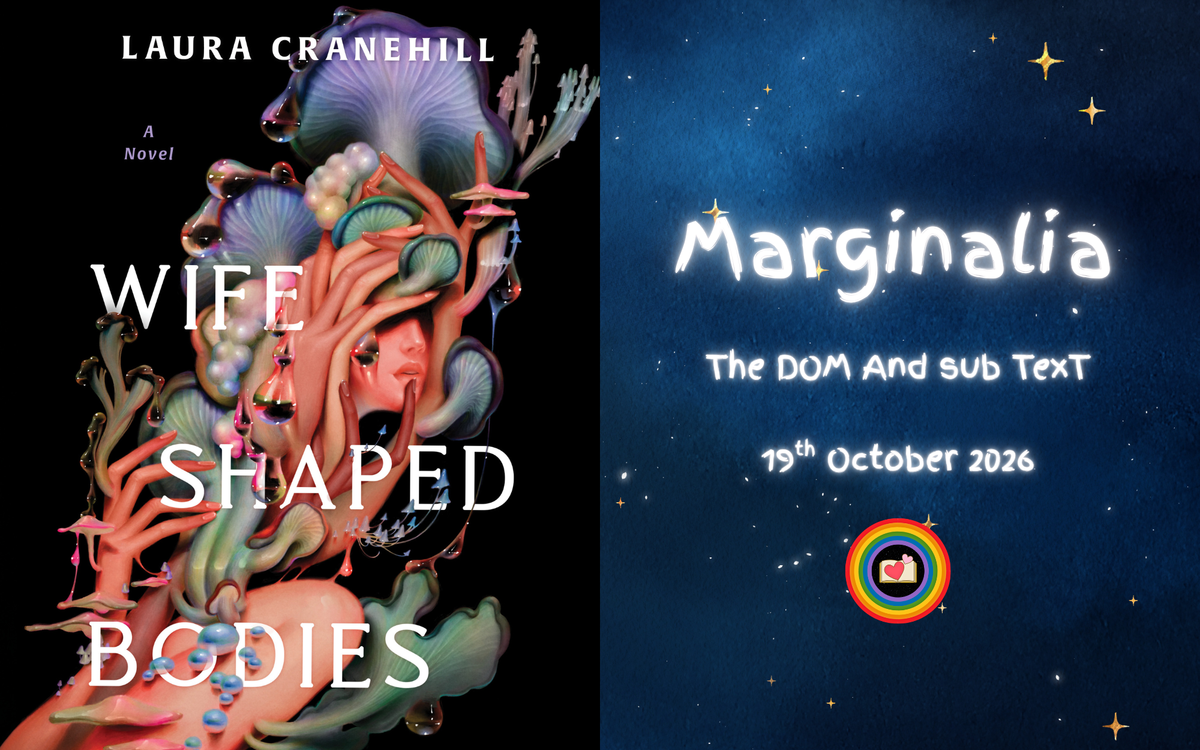
In September, we read Wife Shaped Bodies by Laura Cranehill.
Caveat Lector: the QRB book club is a place for our subjective opinions, and our opinions tell you a lot about us, and less about the book. (The book has excellent reviews and interesting author interviews!) This is not a "Read this book" or a "Don't read this book", it has no critical weight — this is an archive, a summary, a shadow puppet of a two-hour + WhatsApp discussion.
Ze notes, scattered like dandelion fluff through the winds and collected back in a messy bouquet that's more a handful grubbily thrust forward:
(and a big thank you to D for letting me add their thoughtful notes too)
Broadly, most of us didn't like the book, with a few "didn't care either way" and two people (D and G) who liked it and defended it like Hiawatha in that Longfellow poem (D and G: the heroes the book needed but didn't deserve - RM).
We got very loud and heated (Some of us. Some of us were quiet and well behaved. Such is life.)
- Some of us felt it wasn't horror genre. It was horrific, sexual slavery and body weirdness, but not horror. It didn't have that creeping fear of the unknown - we knew what the potential was for what the men could do, we were just waiting for it to unfurl. Some of the others thought that this was horror, textbook creepy and fear that even in this familiar scenario took on that haunting feeling.
- We sort of agreed that horror was the intention. What we disagreed on was whether it succeeded.
- The basic metaphor of the book - of men treating women like empty placeholders for their desires and needs - is pretty one-to-one and maybe simplistic. Did we find it interesting? Some of us yes. Some of us no. For some of us once we knew the men were doing it, it became more like a government conspiracy thriller than horror. Close but not cigar.
- The Men Are Bad Women Are Mushrooms thing was a bit – binary. Why are ALL the men violent rapists? Why did all of them infect all of their women partners (and children!) and not any of themselves?
- The mushroom women are interchangeable with their foremothers. The men are interchangeable with each other.
- Reese is a mystery — why is he what he is? Why is he violent? Why are all the men violent? Why do they kill the mushroom women? Why bother with all this work? Why does Reese kill the mother on the day of Nicole's wedding?
- The men are like tech bros but with mushrooms. Everything is subsumed to their whims.
- Though it does seem like the men would sleep with clones of women who were NOT their partners. Convenient that all the men had partners?
- A lot of the discussion was asking for clarification on plot points we didn't understand. What was funny was we all had different things we were confused by.
- On the prose —I think sometimes it was gorgeous and sometimes it was not working for me. Some of us didn't like any of it! Some of us thought it was fine. Query: should this have been a short story? I think so, though some one suggested it could be fleshed out better and be a nice five hundred page book. As a short story it would have had to pare down to the bone, removing parts we thought were irrelevant or went nowhere good. (Imagine G and D and others strongly refuting this by the way.)
- G pointed out that sometimes the prose was expressing things Nicole couldn't know. Bad writing? Mushroom telepathy?
- Was Nicole numb, or badly written? New poll upcoming. If Nicole is numb, then her numbness is horrific / horror genre. What if Nicole's emotions aren't her own, but are taught to her (by her mother) and she feels them because she doesn't have anything else to feel? Which of her emotions are mushroom telepathy?
- On nostalgia vs hope and the future: Silas didn't take a wife for so long because he was still intent on the future. When that stopped is when he made a wife — and tried to recreate his vision of his family down to the T. Nostalgia and hope are both traps for the foremothers and the mushroom wives.
- On nostalgia vs. beauty: the mushroom wives are being formed from the foremothers to match what the foremothers looked like before, captured in photographs (until recently and even now one of the primary conduits of policing women's bodies). So nostalgia and beauty become the same oppressive yearning in the end.
- We know from one single clear memory that at least Pamela would snap at Silas if she wanted to, so the child brides aren't even replacing the foremothers/the women, they're a fantasy of the subservience the men wanted from their partners.
- The mushroom women are not faceless, characterless dolls — they do have abilities, and it's the ability to connect. They've been using this all the while. It's only Nicole who has been trained to not touch, everyone else has already been sharing. Probably, this is why Teaghan says the baby is from all of them. This is also how they know things!
- D said: The baby is a very interesting piece. After all the babies with all the expectations of repetition, this one finally is fully open to the future. The question is why the ladies even make such a thing, seeing how they don't seem to give a shit about it.
- This baby/child is more image than theme, which is annoying.
- Some of us would have preferred to see the baby/child in more detail. What does it want? Why does it move? done more/deeper. I would have liked her to be conceived by Nicole and Teaghan, for "isnaycnr" (RM note - I do not know what this word is, this is how I typed it. For intimacy? To be conceived on the page? To give Nicole a child she chose? To validate their love? Dear R's brain, do better in every way).
- Or if we saw how Teaghan and the mushroom women came to decide to make the baby. I would have liked to have see the world through the baby's eyes. Speaking just for me, I felt no connection or interest in the baby through the narrative, and so no investment in the future the baby offered us or Nicole.
- On Mothers: Interesting scene with Silas-eating, she experiences connection via Teaghan and begins to consume, she finds the forest and the impulse grows. Strange how it finds its final denouement in a very chill return. This whole Silas-eating becomes so much "oral-mother" in the sense that Deleuze describes, a harsh, winter mother whose intention (or purpose, more likely) is to make a new kind of man. Though D would have loved a taste of blood in the last scene.
- If the baby is meant to represent the future sans oppression, we're not sure how we feel about the impulse to place the burden of the future on the child, and the need she has for it. The baby gives no fucks, however.
- Initially, D felt that as an agent of change the baby's movement was enough — but there's a much better agent of change — THE MOTHER (Mary is not The Mother).
- A talked about how by returning to the ocean the child brings the evolutionary cycle (oceans to lichens to fungi to a lot of things including us) full circle. Conceptually this is a nice idea!
- D loved the Mary. We all generally thought the Mary had potential, if only Nicole had let us into her a bit. It's not a god they're building, it's a gift that feels almost ironic. Sorry we can't bleed for you, here's one who will.
- Joseph is as alive as the foremothers — some of us didn't fully follow the Joseph storyline, and its conclusion is told almost emotionlessly.
- By the end the narrative seems to open two doors to change, one the Mushroom-Plant connection reworking the world, and one final emissary of humanity that seems destined to loneliness, or a return to the Mother. Somehow at the end of all this, it's an anthropomorphic impulse. D was glad she finally chooses return.
- I think a lot of us agreed that there were a lot of missed opportunities - the foremothers who we never saw wake up and fuck shit up, the women and their interactions — which are clearly culturally rich, angry, protective and creative their final climax, the way Nicole killed the men (arson instead of LUCIFERIN FIRE COME ON).
- The sex scene: Of course there was one. This was what we read the book for! I liked it, because suddenly the world and the mushroom growths were full of colour. P2 (alphabetical) thought it wasn't mushroomy or weird enough, while P1 thought it was weird and gross. P2 wrote some beautiful mushroom erotica which a. we want more of and b. mushroom erotica! The world is wonderful if you only connect.
- Why are Nicole and Teaghan drawn to each other? We know Nicole watched Teaghan, but why did Teaghan follow her and tempt her and break boundaries with her? A said there were altogether five interactions between them ("I counted"). A pretty rushed and formulaic romance.
- Some mushroom lore: Mushrooms become, let's call it "ripe for eating" at specific points, after which they mature more and often become poisonous. Within the book Silas says three would be a better more perfect age to "harvest" the mushroom women as wives — but they take them at two. So they're child brides as well as substitutes.
- Some more mushroom lore: mushrooms are being used in Chernobyl to eat up and thus clean the radiation: mycoremidiation. Mushrooms are eating microplastics too. They are very handy things!
- Definitely we feel like the mushrooms aren't used to their fullest potential. This book could be infinitely weirder.
- Nicole's first, forced pregnancy was super weird and then Joseph being born dead (but later plant alive? Like a virus) was sad but also didn't really touch most of us emotionally. One of us said the whole pregnancy was so confusing they couldn't grapple with it at all.
- More things which didn't materialise – Pamela being a ghost in the scenes but never being more.
- On the colour —Nicole doesn't express much about colour because she's shaved it all off and is slowly growing it back!
- D compared Nicole to Maomao of Apothecary Diaries - that their numbness is a tamping down of feeling until they think it isn't there. I think Nicole is a very fearful character tho - that's not numb, she has a clear survival drive and is constantly watching emotion and movement. She does get a little despairing/numb later by the time Maggie etc. die?
- We discussed what would have made the book work for us –- perhaps if it were told entirely from a different character's perspective. By virtue of Nicole's isolation, and then her attendant numbness/overwhelm/lack of knowledge, so much of the plot is happening where we can't see it. What if we saw through Silas's perspective, or the men or the mushroom women, who have a community? And clearly their own little Mother Goddess cult?
- So listen. We all want more mushroom lovemaking, mushroom erotica and mushroom smut in our lives. The weirder the better. Universe and AO3, please give. We are manifesting. 🍄🍄🟫🍄🍄🟫🍄🍄🟫🍄🍄🟫🍄🍄🟫🍄🍄🟫🍄🍄🟫🍄🍄🟫

Quotable quotes:
"Men are bad, women are mushrooms."
"They only interact five times. I counted!"
"What is the Chekov's gun that failed to fire?
"All of them."
"Is he doing cocaine?"
"The women are like photographs."
"You have to squint to see the plot"
"Am I supposed to like the mushrooms?"
Things to read and watch instead of this book:
Queer Theory for Lichens by David Griffiths
The Apothecary Diaries | Kusuriya no Hitorigoto — Anime, two seasons
Haikyuu! by Haruichi Furudate (not for any comparison, just because the lovers insisted)
The Handmaid's Tale by Margaret Atwood
Frankenstein; or, The Modern Prometheus by Mary Shelley
"Union" by Tamsyn Muir
The Locked Tomb series by Tamsyn Muir
Mexican Gothic by Silvia Moreno-Garcia